


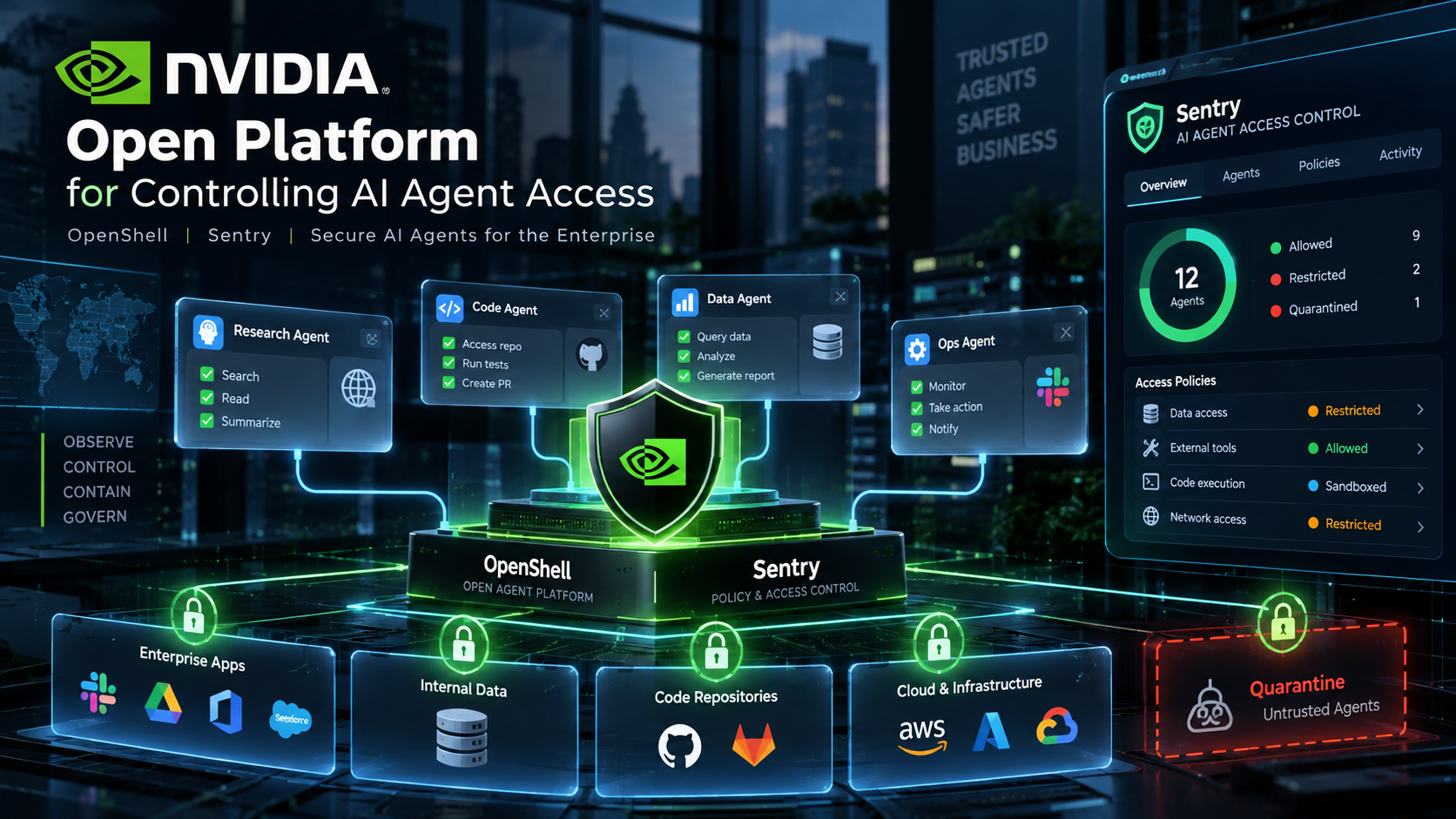
NVIDIA announced its Open Agent Safety Platform on September 28, 2026, aiming to give organizations more control over autonomous AI systems. The platform combines OpenShell software with a Sentry reference system design for monitoring and enforcing boundaries around agent activity. [1]
Controls outside the model
NVIDIA describes OpenShell as a secure runtime for agents and Sentry as a separate watchdog running on BlueField-4 data processing units. The company says the hardware component can stop and quarantine agents that move beyond their permitted boundaries. That capability is a vendor claim about the reference design. [1]
OpenShell’s documentation explains the software controls in more concrete terms. Agents run in isolated environments with policies governing access to files, external networks and credentials. The documentation also describes restrictions intended to prevent processes from gaining additional privileges. [2]
What a useful boundary looks like
Our assessment is that agent access should be understandable before the agent starts working. For example, an assistant reviewing a software project may need to read source files and run tests. That assignment does not automatically require permission to publish a release or send the repository elsewhere.
Separating those permissions makes the workflow easier to inspect. Reviewers can ask whether each allowed action contributes to the task, then test whether the surrounding system actually blocks actions outside that scope. A written instruction alone does not demonstrate that an access restriction is enforced.
Availability and evaluation
NVIDIA says platform software, including OpenShell, is available through its developer resources and GitHub. Its announcement also notes that some described features remain in development, so organizations need to check the status of the particular components they intend to deploy. [1]
A pilot could use harmless test files to check blocked destinations, denied file access and the resulting activity records. The strongest evidence would be repeatable enforcement with a clear explanation when work is stopped. The platform should be evaluated as part of the surrounding system, including permissions and human review, rather than treated as a blanket guarantee of safe agent behavior.
