


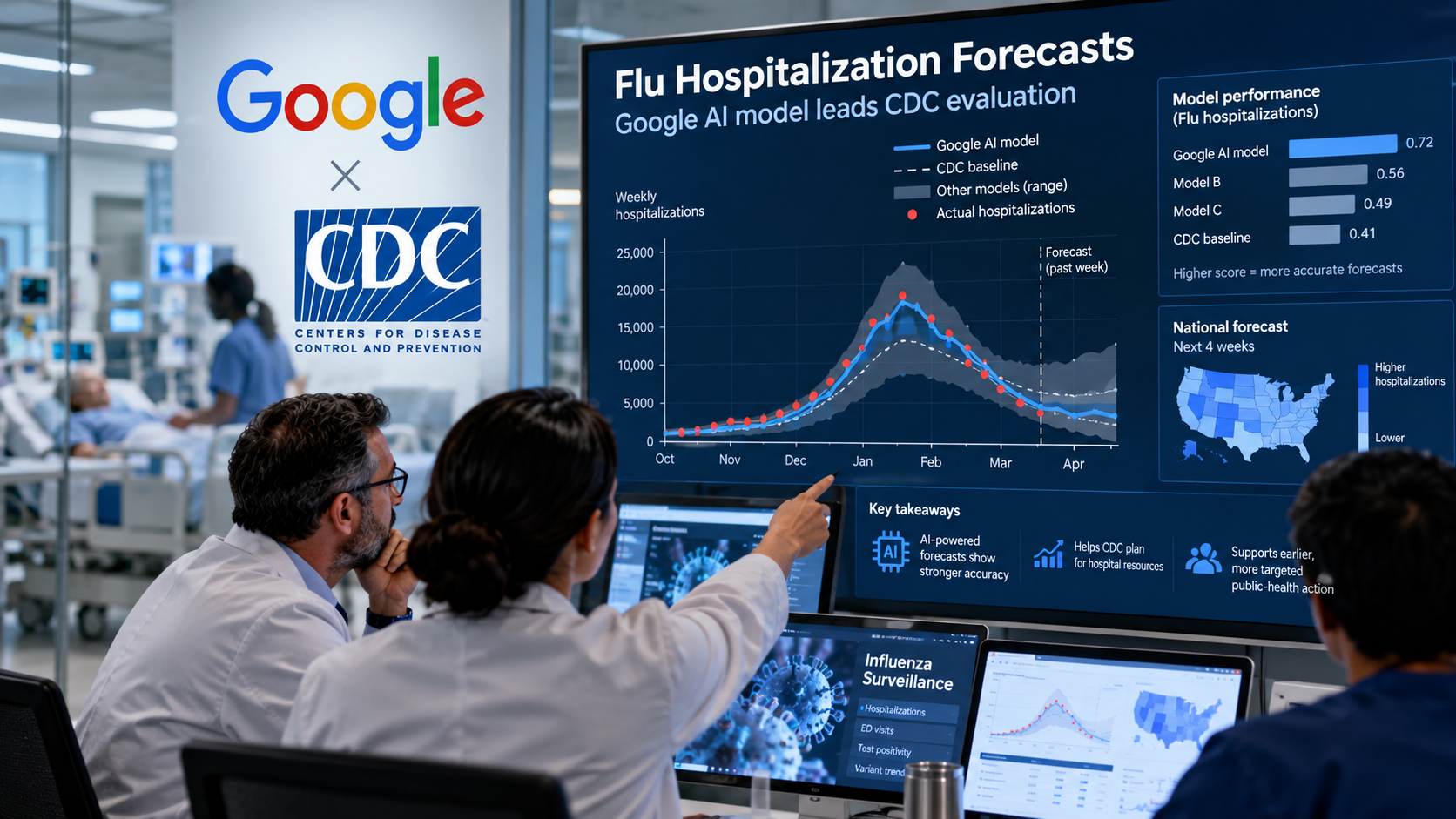
A Google forecasting model was the top-performing individual team submission in the CDC’s evaluation of flu hospital admissions for the 2025–26 season. The results, published on September 30, 2026, compared 39 eligible models. [1]
What the evaluation measured
The CDC assessed forecasts of weekly hospital admissions using a scoring method that considers the relationship between predicted ranges and observed outcomes. The overall ranking excluded national forecasts and compared performance across the included jurisdictions. This was a test of population-level forecasting, rather than the diagnosis of individual patients. [1]
Google says its forecasts were developed using Empirical Research Assistance, an AI tool for generating optimization algorithms. The result provides a concrete example of AI contributing to a scientific workflow with an external evaluation. [2]
A strong result with a defined scope
The CDC also reports that forecast performance declined around periods when influenza trends changed rapidly. Its combined FluSight forecast, used for public messaging, ranked seventh overall. Those findings show why a season-wide ranking needs to be read alongside the conditions under which forecasts became less reliable. [1]
Our view is that this distinction matters for planning. A hospital trying to anticipate pressure on beds or staffing needs both a forecast and an understanding of its uncertainty. A model can perform well across a season while still leaving difficult decisions around an abrupt increase in demand.
The next question is practical usefulness
An operational evaluation could ask whether forecasts arrive early enough to support a specific planning decision. It could also check what happens when estimates change between weekly updates. Those questions connect statistical performance with the work a planning team actually has to do.
Further seasons will help establish how consistently the approach performs under different conditions. For readers following AI research, this result is useful because it names the task, the comparison and the evaluation period. That makes the claim easier to examine than a broad statement that AI can predict disease.
