


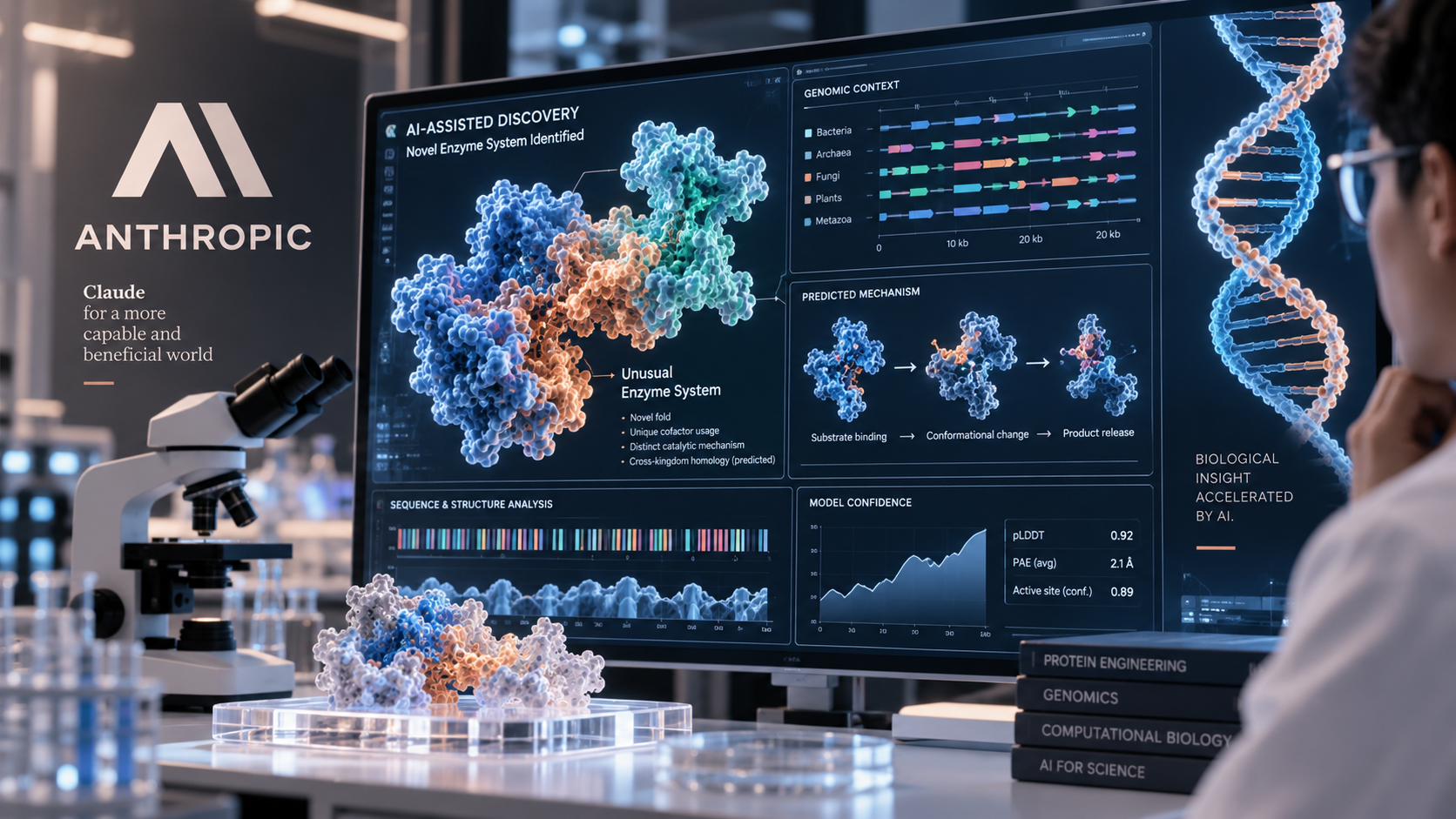
Anthropic reported on September 23, 2026, that Claude helped identify an unusual enzyme system while examining genomic data. The company calls the system array-associated reverse transcriptases, or ART, and says its biological function is still being investigated. [1]
An observation that needs experimental follow-up
According to Anthropic, Claude noticed an array of repeating DNA sequences associated with a reverse transcriptase and an additional protein. Reverse transcriptases are enzymes that copy RNA into DNA. The arrangement drew attention because some of its features resemble those found in programmable biological systems. [1]
Anthropic says scientists provided the initial direction and performed the laboratory work, while agents searched data and analyzed candidates. The company has shared early findings in a preprint. The announcement does not establish a finished gene-editing tool or a medical treatment. [1]
How to judge an AI research contribution
Our interpretation is that a useful AI contribution must leave evidence another researcher can examine. A surprising candidate is a starting point. Reviewers still need to understand why it was selected, which alternative explanations were considered and what experiment could distinguish between them.
That gives research teams a practical way to assess these systems. They could track how many proposed candidates survive expert review, how much effort is needed to check the analysis and whether the supporting records can be reproduced. Producing more suggestions is only helpful if the process also improves the quality of investigation.
Keeping the claim proportional to the evidence
The next meaningful milestone would be a clearer experimental account of what the system does, followed by scrutiny from researchers outside the original team. Readers should distinguish identifying an interesting pattern from demonstrating a dependable application.
For AI-assisted science, this case raises a useful question about the division of work. Software may help explore a large search space, while people decide which evidence deserves further investment. The value of that arrangement will be easier to assess when discoveries can be checked and methods repeated.
