


News date: October 2, 2026
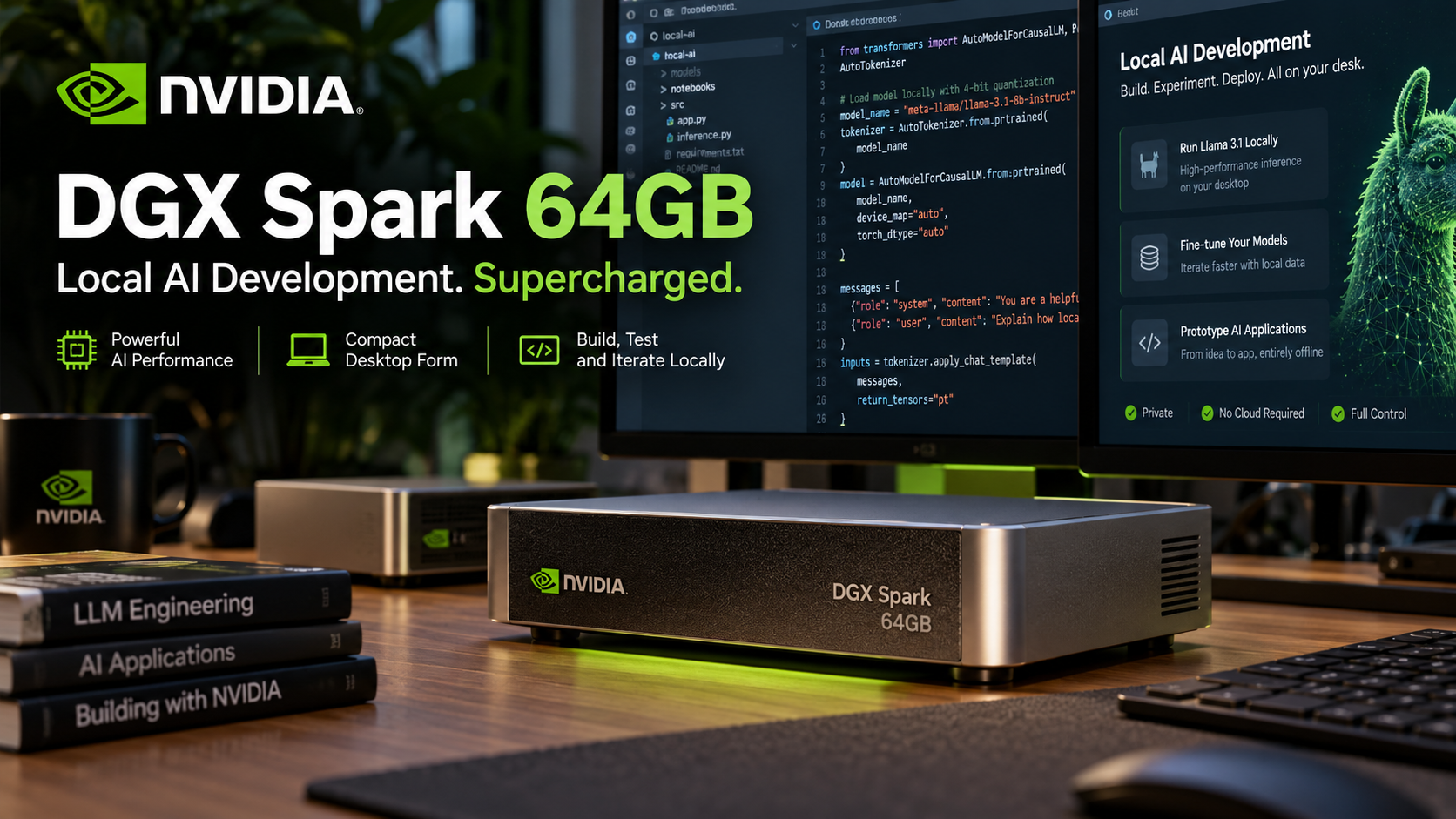
NVIDIA announced a 64GB configuration of DGX Spark on October 2, 2026, expanding its compact systems for local AI development. The company lists availability through manufacturing partners from October 23. As of October 4, that date is still ahead. [1]
Another option for running models locally
The configuration retains the GB10 Grace Blackwell Superchip, DGX OS and NVIDIA AI software stack. NVIDIA positions the system for work including inference, agent development and fine-tuning. It also describes connecting two 64GB systems to provide additional capacity for suitable workloads. [1]
The supporting NVIDIA Sync utility helps users launch applications on remote Linux systems from Windows, Mac or Ubuntu. Its documentation includes a Cluster Assistant for configuring connections between DGX Spark devices, as well as tools for checking network setup and monitoring resources. [2]
Choosing a workload before choosing hardware
Our view is that local AI becomes easier to evaluate when a team starts with one repeatable task. That might be a coding assistant working on an approved repository or a model answering questions about an internal document collection. The first question is whether the chosen model produces useful results on that task.
A practical comparison would then measure response time and memory use with representative inputs. A short demonstration may not reveal what happens when several requests arrive together or a document is much longer than expected. Those conditions can matter more to daily use than a maximum model-size claim.
Scaling still needs an application test
NVIDIA describes a performance increase of up to 1.7 times in its test of two clustered 64GB systems running Qwen 3.8 27B. That is a result for the stated configuration and workload, rather than a promise that every application will gain the same speed. [1]
The announcement gives developers another hardware option to investigate. A useful next step is to test the intended software and model together, including the time needed to maintain the installation. Local access can be attractive, but the complete workflow determines whether it is the right fit.
